A flat battery can end a day on the water before it has even started. Worse still, repeated undercharging can quietly shorten battery life and leave essential equipment without dependable power.
Choosing the right Boat Battery Charger is not simply about buying the model with the highest amperage. The charger must match the battery chemistry, system voltage, bank size, number of batteries and installation environment.
This guide explains how to choose the best boat battery charger, compare the main charger types and avoid the mistakes that often cause damaged batteries or unreliable onboard power.
Some links on this page are affiliate links. This means The Yacht Maintenance Hub may earn a commission if you click through and make a purchase, at no extra cost to you. We only recommend products, tools and marine suppliers that we believe are useful for yacht owners, captains, crew and marine professionals.
Quick Answer: What Is the Best Boat Battery Charger?
The best boat battery charger is a marine-rated smart charger that matches your battery voltage, chemistry, capacity and number of banks. It should recharge the batteries while supporting normal onboard loads without exceeding the manufacturer’s permitted charging current.
What Does a Boat Battery Charger Do?
A marine battery charger converts AC electricity from shore power or a generator into controlled DC power. Unlike an old workshop charger, a smart boat battery charger changes its output as the battery fills.
Most modern chargers use three stages:
Bulk: Replaces most of the lost capacity quickly.
Absorption: Holds the correct voltage while charging current gradually falls.
Float: Maintains the battery without continually applying full charging voltage.
Some models also include a storage mode. As a result, batteries remain ready for use without being heavily charged every day.
Why the Right Charger Matters
Your batteries may power engine starting, bilge pumps, refrigeration, navigation equipment, lighting and communications. Therefore, an unsuitable charger can affect far more than convenience.
An undersized unit may take too long to recover the bank. Meanwhile, an oversized or incorrectly programmed charger may overheat batteries or exceed their recommended charging current.
A dependable boat battery charging system should recharge the batteries within a practical timeframe, support normal dockside loads, use the correct charging profile and provide clear fault information.
In the real world, the right charger should quietly do its job every time you return to the dock.
How to Choose the Right Charger
Match the System Voltage
First, confirm the voltage of the complete battery bank. Several 12-volt batteries may be wired together to create a 24-volt or 36-volt system.
For a standard 12-volt bank, choose a 12v boat battery charger. However, check the wiring diagram or distribution panel rather than relying only on the voltage printed on one battery.
Check the Battery Chemistry
Next, identify whether the batteries are flooded lead-acid, AGM, gel or lithium ion.
An AGM boat battery charger must use a profile approved for the installed batteries. Likewise, a lithium boat battery charger must work with the battery management system and the manufacturer’s voltage, current and temperature limits.
For a larger service bank, a deep cycle marine battery charger should provide controlled multi-stage charging rather than a basic fixed output.
Calculate the Required Output
Charger output is measured in amps. As a starting point, many lead-acid banks use a charger rated at roughly 10% to 25% of the bank’s amp-hour capacity.
Battery bank
10% rate
20% rate
25% rate
100Ah
10A
20A
25A
200Ah
20A
40A
50A
400Ah
40A
80A
100A
These figures are only a guide, so always check the battery manufacturer’s maximum charging current.
Also, allow for equipment running at the dock. For example, if a 40A charger is supplying 20A to refrigeration and electronics, only around 20A remains for charging.
Count the Battery Banks
Many boats have separate starter, domestic, generator or bow-thruster batteries.
A dual bank boat battery charger can serve two banks, while a 3 bank marine battery charger may suit twin engines and one domestic bank. Nevertheless, check whether the advertised current is shared across the outputs.
In addition, confirm whether each output can use a different profile. This matters when the starter battery is AGM but the domestic bank is lithium.
Consider the Installation Location
A waterproof boat battery charger suits small boats or damp lockers. However, higher-output units are often designed for dry, ventilated machinery spaces.
Before buying, consider moisture, ventilation, heat, cable distance, access and fuel-vapour risk. A waterproof label does not make every location suitable.
Main Charger Types Compared
Charger type
Best for
Main advantage
Portable boat battery charger
Occasional charging
Affordable and easy to move
Onboard boat battery charger
Regular marina use
Convenient and automatic
Multi-bank charger
Several batteries
Charges separate banks
Boat battery maintainer
Seasonal storage
Maintains a full battery
Inverter-charger
Larger cruising boats
Charging and AC power together
DC-to-DC charger
Alternator charging
Controls current and profile
For most regularly used boats, an onboard boat battery charger offers the best balance of convenience and reliability. By contrast, a portable boat battery charger may be enough for a small day boat stored ashore.
Charger, Maintainer or Trickle Charger?
A marine battery maintainer keeps an already charged battery ready for use. It monitors voltage and supplies a controlled output when required.
A traditional boat trickle charger may deliver a low current continuously without adapting properly as the battery becomes full. Therefore, a modern automatic marine trickle charger or smart maintainer is generally safer for long-term connection.
A full charger is different because it can restore a significantly discharged battery before moving into float mode.
Shore Power, Installation and Safety
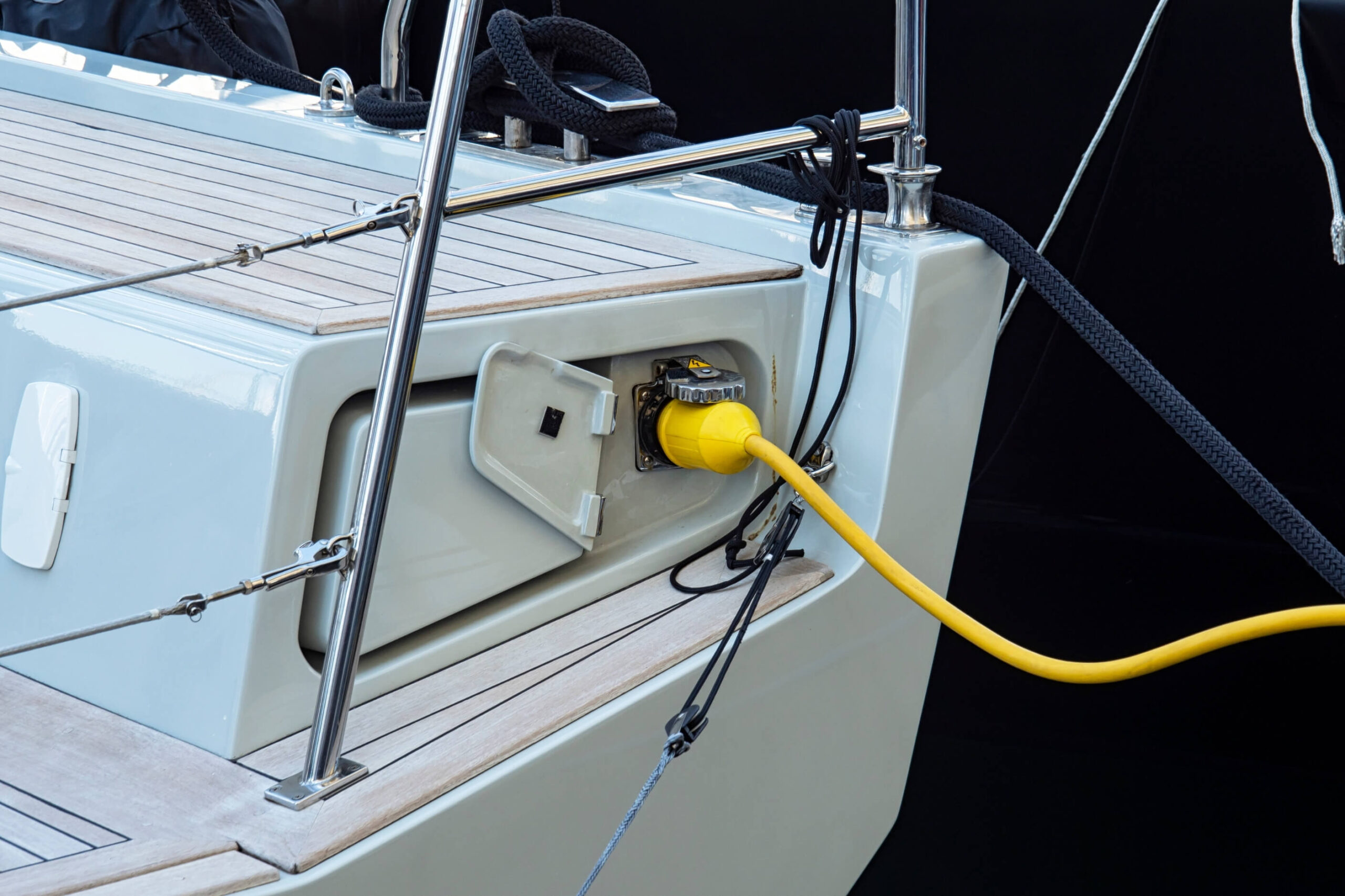
A permanently installed marine shore power battery charger begins charging when the boat connects to a suitable AC supply. This is particularly useful when refrigeration, pumps or monitoring equipment remain active.
However, a fixed boat battery charger installation involves both AC voltage and high-current DC wiring. Poor cable sizing, loose terminals or missing fuses can cause voltage drop, heat or fire.
A sound installation should include:
Correct AC circuit protection
DC fuses close to the battery
Properly sized marine-grade cables
Clean and secure terminals
Suitable ventilation
Correct earthing
The right battery profile
A competent owner may be able to mount a small prewired unit. However, use a qualified marine electrician when altering shore-power wiring, fitting a high-output charger, changing system voltage or converting to lithium.
Typical Boat Battery Charger Costs
Charger category
Typical cost
Portable charger or maintainer
$50–$150
Waterproof one or two-bank charger
$100–$300
Three or four-bank charger
$200–$500
Dry-mount 30A–60A charger
$350–$1,000
Networked yacht charger
$900–$2,500+
Inverter-charger system
$1,200–$5,000+
Installation may add the cost of cables, fuses, breakers, sensors, mounting work and professional labour. Consequently, compare the total installed cost rather than focusing only on the charger price.
Maintenance and Troubleshooting
Although chargers require little servicing, the wider system still needs routine checks.
Interval
Check
Monthly
Confirm normal voltage, current and fault status
Every three months
Inspect terminals for corrosion or heat
Every six months
Clean vents and check cable support
Annually
Test performance across every bank
After replacing batteries
Recheck chemistry and settings
Before storage
Confirm maintenance mode
A boat battery charger for winter storage should have an automatic maintenance mode suitable for the installed batteries. Even then, inspect the system periodically rather than assuming it can be ignored all winter.
Common warning signs include:
Slow charging
Repeated fault codes
Hot terminals or cables
The charger cycling on and off
One battery bank failing to charge
Batteries losing charge unusually quickly
If a battery swells, leaks, becomes unusually hot or gives off a strong smell, stop charging and isolate it safely. Do not keep resetting the charger without finding the cause.
More power is not always better. Voltage, chemistry, bank layout and installation location matter just as much.
Ignoring Onboard Loads
A correctly sized charger may still work slowly when refrigeration, lighting and electronics remain switched on.
Assuming Every Bank Receives Full Output
Check whether the advertised amperage is provided to each bank or shared between all outputs.
Mixing Battery Chemistries Carelessly
AGM and lithium banks may require different charging profiles. If the outputs cannot be configured separately, choose another charging arrangement.
Using an Automotive Charger Permanently
Workshop chargers are not always designed for damp marine spaces, fixed mounting or continuous shore-power use.
Forgetting to Update the Settings
Whenever batteries are replaced, recheck the charging profile, capacity and temperature settings before using the charger.
Boat Battery Charger Buying Checklist
Before ordering, confirm:
System voltage and battery chemistry
Total battery capacity in amp-hours
Maximum permitted charging current
Number of separate battery banks
Required charging profile for each bank
Normal onboard electrical loads
Available shore-power capacity
Waterproof or dry-mount requirement
Cable and fuse requirements
Monitoring requirements
Possible future battery upgrades
FAQs: Best Boat Battery Chargers
What size boat battery charger do I need?
For many lead-acid systems, start with roughly 10% to 25% of the battery bank’s amp-hour capacity. Then check the battery manufacturer’s limits and include any equipment operating during charging.
Can I leave a boat battery charger connected continuously?
A correctly configured smart charger can usually remain connected when it has a suitable float or storage mode. However, inspect the charger, batteries and shore-power system regularly.
Can one charger handle AGM and lithium batteries?
Only when it provides suitable independently controlled outputs or the manufacturer approves the arrangement. Never assume every multi-bank charger can use a different profile for each output.
Is a battery maintainer the same as a charger?
No. A maintainer keeps an already charged battery ready for use, while a charger can recover a more deeply discharged battery before moving into maintenance mode.
When should a marine battery charger be replaced?
Replace it when charging becomes unreliable, faults keep returning, terminals show heat damage or the unit no longer supports the installed battery chemistry
Conclusion
Choosing the right Boat Battery Charger means matching it to the complete electrical system. Check the voltage, chemistry, capacity, number of banks and normal onboard loads before comparing products.
Most importantly, do not overlook installation quality. Correct cables, fuses, ventilation and settings turn a good charger into a reliable system.
Once fitted, record normal charging performance and investigate changes early. That simple habit can prevent flat batteries, damaged equipment and expensive electrical faults.
Join the newsletter for practical yacht maintenance advice, new guide releases, downloadable resources, product recommendations and seasonal reminders designed to help owners, captains and crew make better maintenance decisions onboard. As TYMH grows, subscribers will also get early access to new checklists, maintenance resources, recommended products and exclusive offers or discounts from selected marine brands.
Success
Thank you for signing up to receive updates from The Yacht Maintenance Hub.
Blog / Best Boat Battery Charger: How to Choose the Right One for Your Boat
We track how people interact with our online web content and resources, and some of that tracking involves storing cookies on your device. By continuing to use our site you accept that you agree to this. For more details see our Privacy Statement.
 310
310
310
310